MVP (Minimal Viable Product): It’s crucial to start with something ridiculously simple to give to the first users, checking if we can add any value to them.
Some understanding of the problem is very helpful when building an MVP, so please talk to your users before writing code.
There’s no need for three years of research, but some is fine. Even better if you are the user.
How to get first users is a weird question because the reason to start a startup is to solve somebody else’s or your own problem. They should be the user.
If you are building a startup for an unknown group of users, beware!
Goals of pre-launch startups include:
Launching (something basic) quickly. The rest of the presentation summarizes this.
Getting initial customers (No need to acquire every customer, just a few to see if it brings any value to them). Many startups end before a single user interacts with them. PLEASE GET THROUGH THIS STEP.
Talking to customers and getting feedback. Most founders have an idea of what they want to build, but if they didn’t build the full thing, feedback for the shitty product is useless. The idea should stay in your head as it’s possible it’s not what users want.
Iterating to improve the product. Iteration is crucial in the development process, especially distinguishing it from pivoting. Founders sometimes pivot too quickly, attempting to solve different problems when their initial solution fails. However, the focus should remain on refining the solution to address the original problem effectively. For instance, if a screwdriver doesn’t work for a mechanic, the solution isn’t to find other uses for it but to improve its ability to screw in bolts. Therefore, continual iteration is essential to ensure that the solution aligns with the user’s needs.
Lean MVP (built in weeks, not months). This can involve software or, honestly, startups can start very, very fast with just a landing page and a spreadsheet. But most startups can start very, very fast. Extremely limited functionality is necessary. You need to condense down what your user needs, what your initial user needs, to a very simple set of things. A lot of times, founders want to address all of their users’ problems and all of their potential users, when in reality, they should just focus on a small set of initial users and their highest-order problems, and then ignore the rest until later. MVP is just a start, don’t fall in love with it.
How these started
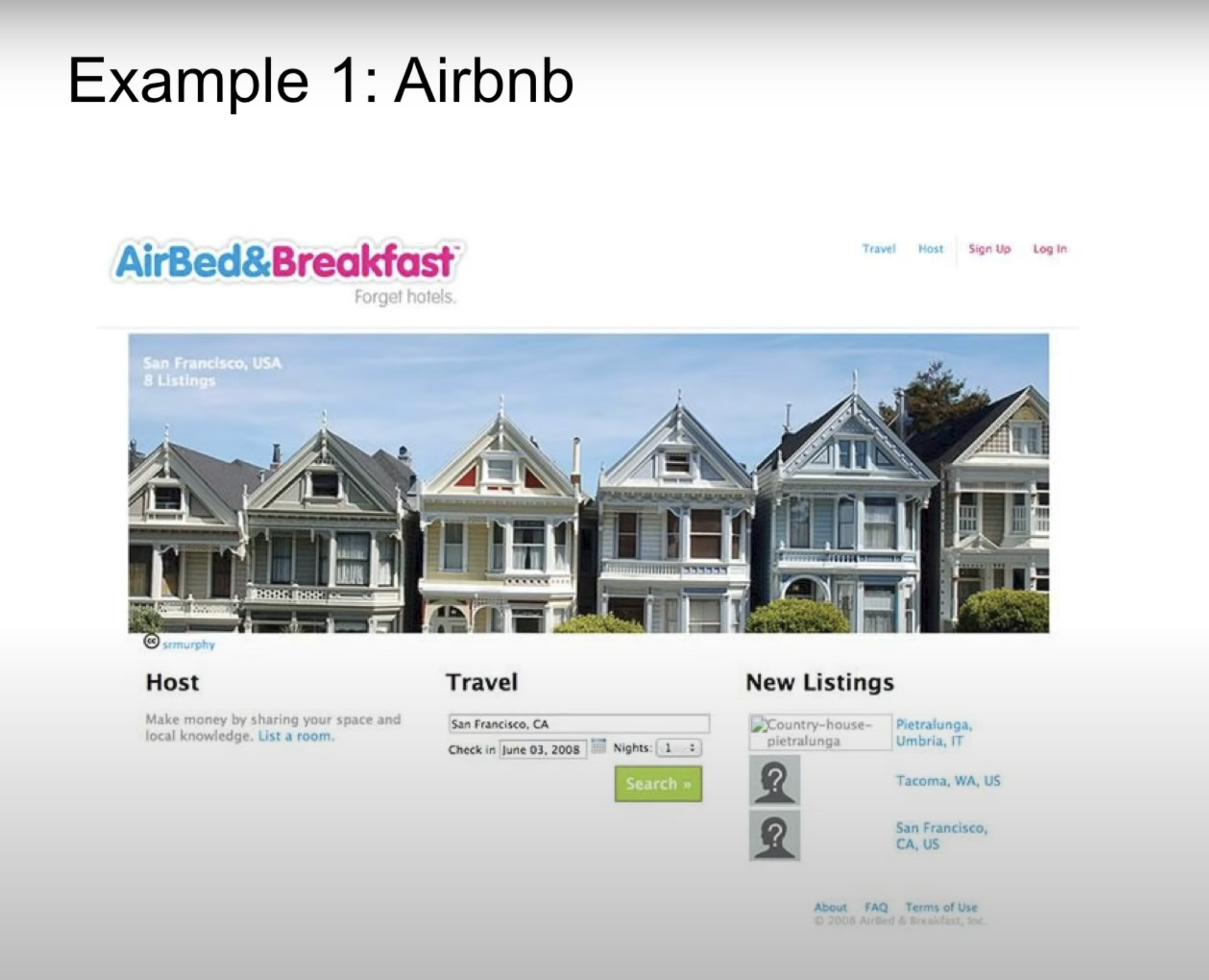
Airbnb: No payments, exchange in person. No map view. Everyone talks about awesome stories, but everything was far from perfect - bullshit.
Twitch: Only one channel, if you don’t like it, leave. Low resolution. No video games.
Stripe: No bank deals, few features. Founders would integrate it for you (They were desperate to find users and they could catch bugs before users).
Heavy MVP (You need to build this in a few cases): Significant regulations (insurances, banks), hardtech, biotech, moonshots. MVP can still start with a simple webpage.
Launching: Facebook - we remember tons of press releases, getting a lot of buzz, etc. How many people remember the day that Google launched? Nobody, well, because we are young. So it turns out that launches aren’t that special at all, okay? So if you have this magical idea of your magical launch you want to do, throw it away. It’s not that special. The number one thing that’s really important is to get some customers. Let’s push the press launch off, and let’s push the get-any-customers launch really, really soon. That’s our goal here.
It’s a lot harder to learn from your customers when they don’t have a product they can play with. If you put the thing in front of them, and it doesn’t solve their problem, you know right away. Spending all that time on a pitch deck is not as valuable as spending your time building anything that you can give to a customer.
Hacks for building an MVP extremely quickly:
Time-box your spec (Launch in 3 weeks).
Write your spec: It’s really easy to change what you’re working on before you ever launch it because you never write it down. You start working on something, you talk to a user, they say, “Oh, I would never use that,” or God forbid, you talk to an investor and they say, “Oh, that could never be a company because investors know everything.” And so you decide to change what you’re working on. And because you never wrote it down, you don’t even really realize you’re changing it. And so your three-week plan turns into a three-month plan. If you write shit down, at least you can be honest with yourself that you’re changing your spec all the time.
Cut your spec: Cut the stuff that clearly isn’t important. Most of the goal here is just to get anything out in the world. It’s easy to delay, delay, delay. Don’t fall in love with your MVP. So many people fall in love with the vision in their head. And none of the products I showed you before was the initial vision, what it ended up being. You wouldn’t fall in love with a paper you wrote in the first grade.